

Fergus House, Quin Road Business Park, Quin Rd, Ennis, Co Clare
 Access Control Systems
None Available
Monitor Intruder Alarms
Private Security Authority Licence 00484
Every home and business is different and every person has different priorities when it comes to securing their home and business. With your suggestions and Monitor's experience in the security industry, we will come up with the most effective system for your premises. The following is a brief explanation of some of the main components available to you to aid in securing your home and business.
The wireless systems are easy and quick to install, as there is very little cable required. The main advantage of this system is that detectors can be placed around the premises without having to cause any disruption to the building itself. The components of the wireless system are very similar to the hardwired system and work on exactly the same principles. The wireless components operate by sending a signal back to the control panel, which acts as a receiver. It then translates the radio signals in the same way as a hardwired panel would translate the signals from a multi-core cable.
Radio Transmitters have to be powered by their own batteries. In order to conserve battery power, motion detectors operate a sleep period of approximately 3 minutes, each time they detect someone in their area. Batteries require regular replacement, which Monitor will advise you of.
Bells and sirens alone can no longer guarantee a response to your Intruder Alarm System. 24 hour monitoring directly links your security system to a Central Monitoring Station, with controllers on standby, ready to respond to the signalled emergency.
There are three options with regards to the connection method to the CMS:
How it works:
All systems installed by Monitor are installed in accordance with NSAI standards EN50131. Under these regulations, it is advised that Intruder Alarms Systems receive two maintenance checks per year. The more a system is maintained and looked after, the less likely it is to give false alarms. Of course we cannot guarantee complete false-alarm free systems, but we can advise to our customers to take out a maintenance contract with us after twelve months. The first twelve months of service is free of charge under the terms of our warranty contract. After this initial period, there is an annual cost, which we will advise of you in writing.
EN50131/1:2006 NSAI, and other certification bodies, offer a range of certification schemes to companies operating within the security industry. These certifications give the consumer the assurance that what they are purchasing, be it a product or a service, come from a company operating to the best international standards.
NSAI operates a certification scheme based on Irish Standard I.S. EN 50131/1:2006 - Alarm systems, intrusion and hold up systems. Under the scheme, NSAI inspectors assess the operations and procedures of alarm installers by:
When the inspectors are satisfied that compliance has been achieved, they will then grant the alarm installer an Irish Standard Mark Licence. This entitles the certified installer to use the Irish Standard Mark on and in connection with installations. (Link to NSAI site)
The Government of Ireland through the Private Security Services Act, 2004, established the Private Security Authority which took up office in that year. It is the aim of the Authority to use the statutory regulation and enforcement powers provided to it to introduce positive, fundamental change in the industry. Our purpose is to instil customer and public confidence in this multi-stranded, multi-faceted business with the introduction, control and management of a comprehensive, standard driven, licensing system for all individuals and companies involved in the industry and to do so in a manner that is sensitive to the needs of the market. (Link to PSA site)
Garda policy changes were introduced on April 1st 2005. These changes affected the handling of activations from an intruder alarm system. The Gardai now only respond to 'verified' alarms.
What is a verified alarm?
A verified alarm is an alarm system that has sent in a second signal to confirm the first activation. Many primary signals are accidental as a result of weather or not switching off an alarm in good time. The second, or 'verifying', signal will narrow the probability of an activation being false.
The Gardai will not accept a call from a Monitoring Centre until a keyholder has been notified and given an estimated time of arrival at the premises.
The purpose of the new policy is to reduce false alarms thereby enabling the Gardai to respond to real activations more promptly.
What is a false alarm?
If the Gardai arrive at a premises and the Keyholder is not there the activation will be treated as a false alarm. Garda response will be withdrawn when the limit of three false alarms in three months is reached. If Garda response is withdrawn, the alarm system must have verification technology installed before it can be reinstated.
All Commercial systems must have verification technology installed prior to January 1st 2007.
Every home and business is different and every person has different priorities when it comes to securing their home and business. With your suggestions and Monitor's experience in the security industry, we will come up with the most effective
system for your premises. The following is a brief explanation of some of the main components available to you to aid in securing your home and business. Wireless Systems
The wireless systems are easy and quick to install, as there is very little cable required. The main advantage of this system is that detectors can be placed around the premises without having to cause any disruption to the building itself. The components of the wireless system are very similar to the hardwired system and work on exactly the same principles. The wireless components operate by sending a signal back to the control panel, which acts as a receiver. It then translates the radio signals in the same way as a hardwired panel would translate the signals from a multi-core cable.
Radio Transmitters have to be powered by their own batteries. In order to conserve battery power, motion detectors operate a sleep period of approximately 3 minutes, each time they detect someone in their area. Batteries require regular replacement, which Monitor will advise you of.
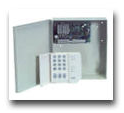
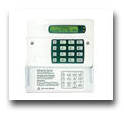
Control Panel: We use the latest technology with the HKC Control Panel. This supports up to 70 wireless detector connections, 2 wireless repeaters and up to 32 users. Features:
|
 |
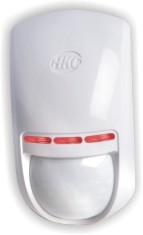
Wireless PIR: Used for dectecting movement and the body heat of intruders
|
  |
Wireless Panic Button: Can be used from anywhere to Arm/Disarm your alarm system
|
 |
| Shock Detectors: We use the HKC RF-CSW wireless shock detector with magnetic contact option situated on your windows and doors. Shock sensors trigger the alarm when vibration is applied by an intruder to a window or door where they are situated. Magnetic contact option tells the system when the window or door is opened. | 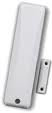 |
| Wireless External Siren: Saves on wiring and hassle - The external siren is situated on the outside of the house. It is a white polycarbonate box with the Monitor logo printed on it. As well as being a deterrent in itself, the external siren emits a very loud noise and the built-in strobe flashes continuously. |  |
Hardwire Systems
As the name suggests, this type of security system requires cable to be ran to each component of the alarm system. It is not always feasible to run cables in a building that has been completed, but a site survey would quickly determine if it is possible or not. The components of a hardwire system are basically the same as a wire-free system. The major difference, bar the absence of cables, is that the hardwire components are mains operated and have a standby battery backup in case of power failure.Monitoring Service
Bells and sirens alone can no longer guarantee a response to your Intruder Alarm System. 24 hour monitoring directly links your security system to a Central Monitoring Station, with controllers on standby, ready to respond to the signalled emergency.
There are three options with regards to the connection method to the CMS:
- a) Via landline – your landline is connected to your alarm panel. This is the most common form of connection. It is reliable, however, your phone cable can be cut in the event of a break in, severing your connection with the CMS
- b) Via GSM – a SIM card on a GSM unit can also provide connection to the monitoring station instead of a landline. This connection is dependant on a solid mobile signal. The signal can also be blocked by an intruder using a GSM blocker.
- c) Via Radio Link - Long range wireless radio monitoring, provides a highly secure, highly reliable backup to the Central Monitoring Station and eliminates the 'weak link' in conventional alarm systems. Radios are positioned so as to make location and access difficult. This means that even if an intruder knows where the radio is they will not have time to reach it before it sends in an activation signal
How it works:
- Step 1: An alarm system activates and a signal is sent to the Central Monitoring Station.
- Step 2: The Monitoring Station receives a signal and the customer's details automatically flash on the screen within seconds.
- Step 3: A controller immediately acts on your behalf notifying the Gardai, keyholders and other relevant emergency services.
Maintenance Service
All systems installed by Monitor are installed in accordance with NSAI standards EN50131. Under these regulations, it is advised that Intruder Alarms Systems receive two maintenance checks per year. The more a system is maintained and looked after, the less likely it is to give false alarms. Of course we cannot guarantee complete false-alarm free systems, but we can advise to our customers to take out a maintenance contract with us after twelve months. The first twelve months of service is free of charge under the terms of our warranty contract. After this initial period, there is an annual cost, which we will advise of you in writing.
Industry Standards and Regulations
EN50131/1:2006 NSAI, and other certification bodies, offer a range of certification schemes to companies operating within the security industry. These certifications give the consumer the assurance that what they are purchasing, be it a product or a service, come from a company operating to the best international standards.
NSAI operates a certification scheme based on Irish Standard I.S. EN 50131/1:2006 - Alarm systems, intrusion and hold up systems. Under the scheme, NSAI inspectors assess the operations and procedures of alarm installers by:
- Inspecting a number of their alarm installations
- Comparing the results with the requirements of I.S. EN 50131/1
- Bringing any anomalies or non-compliances to the installer’s attention
- Specifying any necessary corrective actions
- Reviewing the corrective actions.
When the inspectors are satisfied that compliance has been achieved, they will then grant the alarm installer an Irish Standard Mark Licence. This entitles the certified installer to use the Irish Standard Mark on and in connection with installations. (Link to NSAI site)
Private Security Authority
The Government of Ireland through the Private Security Services Act, 2004, established the Private Security Authority which took up office in that year. It is the aim of the Authority to use the statutory regulation and enforcement powers provided to it to introduce positive, fundamental change in the industry. Our purpose is to instil customer and public confidence in this multi-stranded, multi-faceted business with the introduction, control and management of a comprehensive, standard driven, licensing system for all individuals and companies involved in the industry and to do so in a manner that is sensitive to the needs of the market. (Link to PSA site)
Garda Policy
Garda policy changes were introduced on April 1st 2005. These changes affected the handling of activations from an intruder alarm system. The Gardai now only respond to 'verified' alarms.
What is a verified alarm?
A verified alarm is an alarm system that has sent in a second signal to confirm the first activation. Many primary signals are accidental as a result of weather or not switching off an alarm in good time. The second, or 'verifying', signal will narrow the probability of an activation being false.
The Gardai will not accept a call from a Monitoring Centre until a keyholder has been notified and given an estimated time of arrival at the premises.
The purpose of the new policy is to reduce false alarms thereby enabling the Gardai to respond to real activations more promptly.
What is a false alarm?
If the Gardai arrive at a premises and the Keyholder is not there the activation will be treated as a false alarm. Garda response will be withdrawn when the limit of three false alarms in three months is reached. If Garda response is withdrawn, the alarm system must have verification technology installed before it can be reinstated.
All Commercial systems must have verification technology installed prior to January 1st 2007.
Fergus House, Quin Road Business Park,
Quin Rd, Ennis, Co Clare
Telephone: +353 (0)65 6829111 - Fax: +353 (0)65 6867712 - Company Registration Number: 222806
PSA Licence Number: 00484
Quin Rd, Ennis, Co Clare
Telephone: +353 (0)65 6829111 - Fax: +353 (0)65 6867712 - Company Registration Number: 222806
PSA Licence Number: 00484

